Innovative ZF transmission systems
Identities given by laser marking
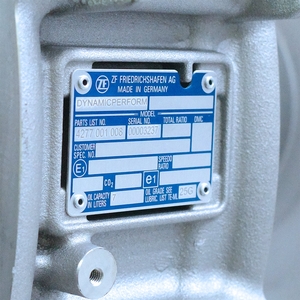
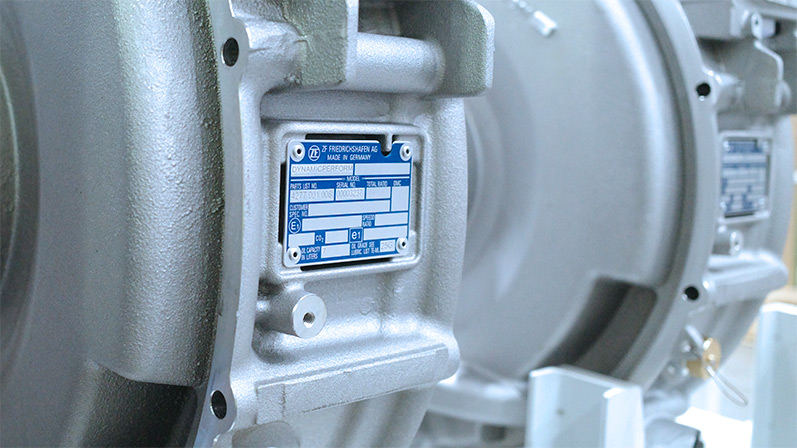
Friedrichshafen along Lake Constance, “Zeppelin City”: Every year, several hundred thousand highly developed drivelines, transmissions, axles, and steering systems are fabricated at the headquarters of ZF, a global automotiove supplier. The systems ensure the mobility of passenger cars, commercial vehicles and industrial equipment all around the world. Thanks to typeplates, the products can be unambiguously identified at any time. XENO 1 fiber laser stations by cab are marking the aluminum plates at facility 1 in Friedrichshafen with pinpoint accuracy, resistant to wear and permanent.
Typeplates ensure, for instance, driveline solutions being traceable and implemented in optimum manner. Key data may be the name of a manufacturer, series and model designations, year of construction. Customer numbers, rotational speeds, power ratio resulting of rotational input and output speeds all play further roles, so do oil specifications. The so-called machinery directive applies.
Dynamic in every way
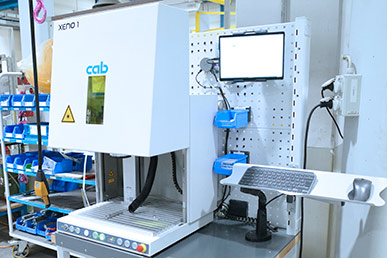
- A compact XENO 1 desktop system, demanding little footprint but offering a large work area.
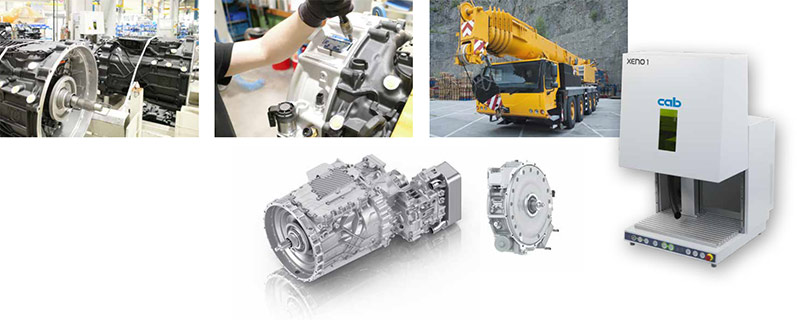
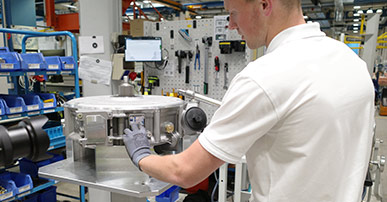
At the end of a highly precise process chain ‒ ranging from design and component production through assembly to functional testing ‒ transmissions take on identities. “See here our DynamicPerform elements as an example,” says Michael Walter, production engineer in the ZF Marine & Special Driveline Technology business section. “DynamicPerform,” he further adds, “is ZF’s proven TraXon transmission enhanced by a clutch module. It matches notably with three- to five-axis mobile cranes that move heavy loads and must maneuver with precision.”
ZF operators professionally punch marked typeplates onto the transmissions. “The plates are for identification, tracing and quick service diagnostics,” says Mr. Walter. “Markings must remain legible to our technical staff even after years of use. This is fundamental to assure customers immediate assistance, such as by procuring a spare part.” Data on transmissions are throughout their lifespan exposed to mechanical and environmental impacts, for example wear, light, extremely high or low temperatures.
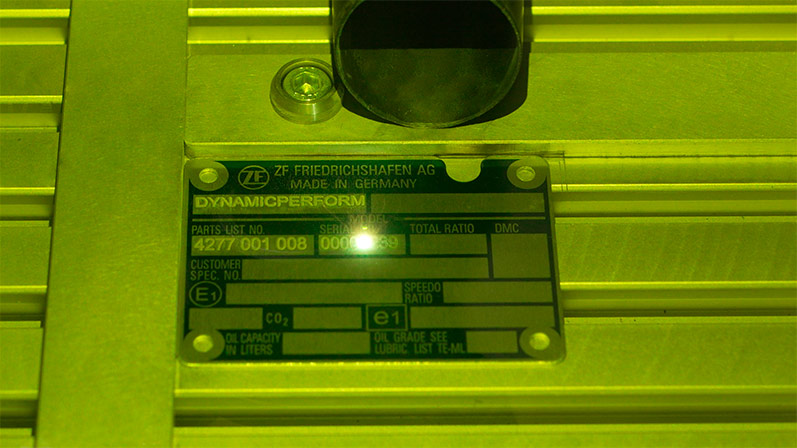
- Markings exerted by a fiber laser offer various benefits: focusability on smallest spaces, high processing speeds and no mechanic al stress exerted on the component
Why laser marking is first choice
Fiber laser technology impresses wherever top-notch and durable markings are on demand, and a marking system must provide a long lifespan. Such features makes it specifically economical. ZF operates two cab XENO 1 systems in its manufacture in Friedrichshafen. Perfectly adapted to the application, they achieve high efficiency. A motor-driven z-axis allows heights been adjusted quick and easily using a focus finder. A scan head is linked to the beam source. A featured planospherical lens bundles the laser beam. It also enables specified marking fields be covered. A pilot laser simulates a marking process, while interior LED lighting simplifies observation when the workroom door is closed. XENO systems at ZF provide cablase automation software.
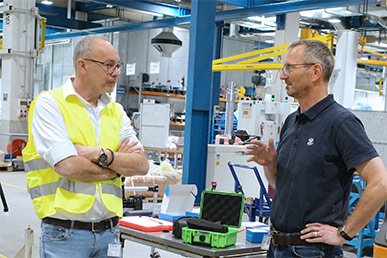
- Partners on equal terms: Michael Walter (right) and cab consultant Wolfgang Bayerle
Fixed and variable data
Each XENO 1 is linked to a PC at its respective workstation. A handheld scanner is provided. ZF operators use it to scan a barcode or 2D code on the relevant task card. A desired plate design is selected as defined by the scan. Part list and order numbers are automatically retrieved as fixed data from an Excel sheet in the ERP system and entered into the fields on the typeplate ‒ along with the manufacturer as a variable number. The laser image is displayed on the monitor to an operator. Pressing the start button on XENO 1 triggers the marking process.
A successful collaboration
Mr. Walter recalls: “I first came across cab in early 2024.” At that time, the ZF Group already had cab equipment successfully in use at other facilities. “I was able to contact the sales representative through the homepage. Mr. Bayerle evaluated our requests and recommended XENO 1. We were later given a demonstration of the system at the cab showroom in Karlsruhe. In the end, the compact design and ease of use of XENO 1 were deciding factors. We have so far been very satisfied with the performance of the systems and also with their availability. The cab company provided expert support and training during rollout, implementation to our facilities and the plates design. Our cab service contacts respond quickly and straight whenever there are questions.”
ZF Group
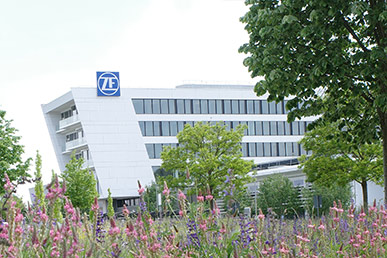
Founded in 1915 as a gear factory, ZF is today a global technology company. Advanced mobility products and systems are supplied for passenger cars, commercial vehicles and industrial technology. The comprehensive ZF product range is primarily aimed at vehicle manufacturers, mobility providers and start-up companies in transportation and mobility. ZF electrifies a wide range of vehicle types. With its products, the company contributes to reducing emissions, protecting the climate as well as enhancing safe mobility. Alongside the automotive sector – passenger cars and commercial vehicles – ZF also serves market segments such as construction and agricultural machinery, wind power, marine propulsion, rail drives and test systems. With some 153,000 employees worldwide, ZF reported sales of €38.8 billion in fiscal year 2025. There are 162 production locations in 29 countries. www.zf.com
Video of this operation
Case study: Innovative ZF transmission systems - Identities given by laser marking
October 2026